
Millions of men deal with hair loss every single day. Some notice it early, a widening part or a thinner crown. Others wake up one morning and realize the change has gone further than expected. Either way, the search for an effective male hair loss treatment tends to follow the same exhausting path: serums, pills, shampoos, supplements, and plenty of disappointment. But does that really help?
Why Do So Many Male Hair Loss Treatments Fall Short?
The root cause of most male hair loss is androgenetic alopecia, commonly known as male pattern baldness. A hormone called dihydrotestosterone, or DHT, gradually shrinks hair follicles over time. Once a follicle weakens past a certain point, no topical serum or growth supplement can reverse that damage.
That explains why so many men spend months applying minoxidil or finasteride and see only modest results. These medications work best in the early stages of hair loss. They slow progression. They rarely deliver full regrowth. For men who ask, “Why is my hair loss treatment not working?” the answer usually comes down to timing, follicle health, and genetics working against them.
What Does Actually Work For Male Pattern Baldness?
Minoxidil remains one of the most widely recommended male hair loss treatments. It increases blood flow to the scalp and extends the hair growth cycle. Results take four to six months of daily use before becoming visible, and gains disappear once you stop. Finasteride targets DHT directly and shows stronger long-term results for many men, but it carries potential hormonal side effects that put some people off.
Platelet-rich plasma therapy, known as PRP, gained attention in 2026. The process concentrates growth factors from a patient’s own blood and injects them into thinning areas. Clinical evidence continues to build, and results can be promising for men with moderate hair loss. However, multiple sessions add up, and the outcomes still vary widely.
Low-level laser therapy stimulates scalp circulation and supports follicle health. Hair transplant surgery, particularly follicular unit extraction, moves healthy follicles from donor areas into bald patches and delivers permanent results. Both carry high costs and time commitments.
Can Hair Loss Be Treated Without Surgery?
Absolutely. Many men achieve meaningful results through non-surgical routes, especially when they act early. Combination therapy, pairing topical minoxidil with oral finasteride, remains one of the most clinically supported approaches for androgenetic alopecia. Newer options like JAK inhibitors and experimental follicle-stimulating compounds are entering trials and drawing attention, though most remain years from mainstream use.
The honest reality for many men, however, is that none of these treatments deliver guaranteed density. Results depend on how far hair loss has progressed, individual response to medication and consistent long-term commitment. When follicles are gone, they take regrowth options with them.
When conventional hair loss treatments stop delivering results
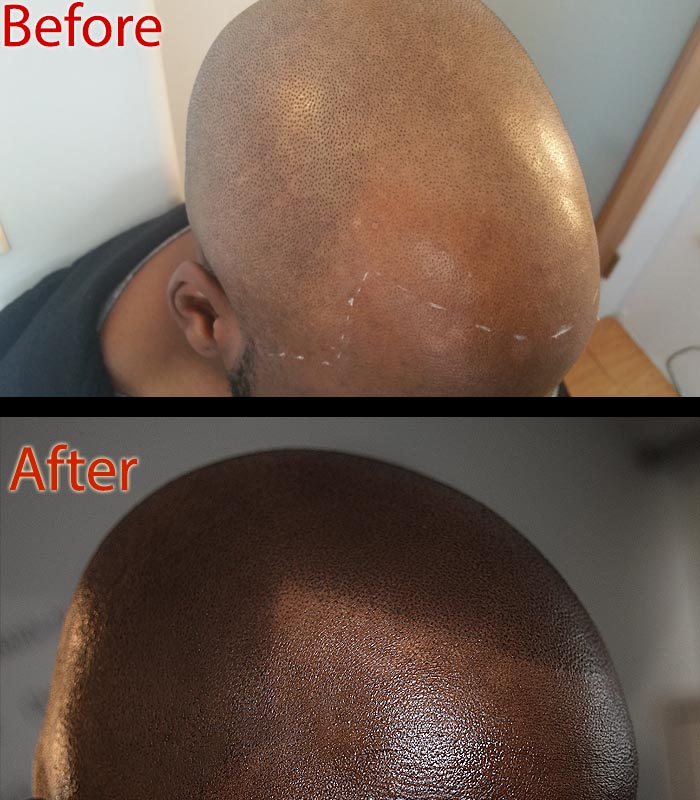
This is where a growing number of men are turning to scalp micropigmentation. SMP does not depend on follicle health. It does not require months of waiting or daily application. Instead, it uses precise pigment deposits on the scalp to replicate the natural appearance of close-cropped hair or a shaved head. The effect looks immediate, realistic, and far more durable than most people expect.
Men with receding hairlines, thinning crowns, and complete baldness all benefit from SMP. It also works exceptionally well for those who have tried and abandoned conventional male hair loss treatments without satisfying results.
But Your Search Doesn’t End Here!
Here is where many men get into trouble. The rise in demand for scalp micropigmentation has attracted practitioners from traditional tattooing backgrounds who market themselves as SMP specialists. Tattooing and scalp micropigmentation share surface-level similarities, but they are fundamentally different disciplines.
SMP requires an understanding of scalp anatomy, precise needle depth, pigment formulation designed specifically for skin tone, follicle simulation, and the ability to build a hairline that looks natural from every angle.
A tattoo artist without proper SMP training frequently uses the wrong pigment depth, which causes color migration over time. Hairlines come out too sharp, too dark, or positioned incorrectly for the client’s face shape. Fixing poor SMP work costs far more than doing it right the first time.
The key is finding a trained Arizona SMP specialist who brings the skill to back it up. You can find scalp micropigmentation Arizona professionals at DermiMatch Clinic.