
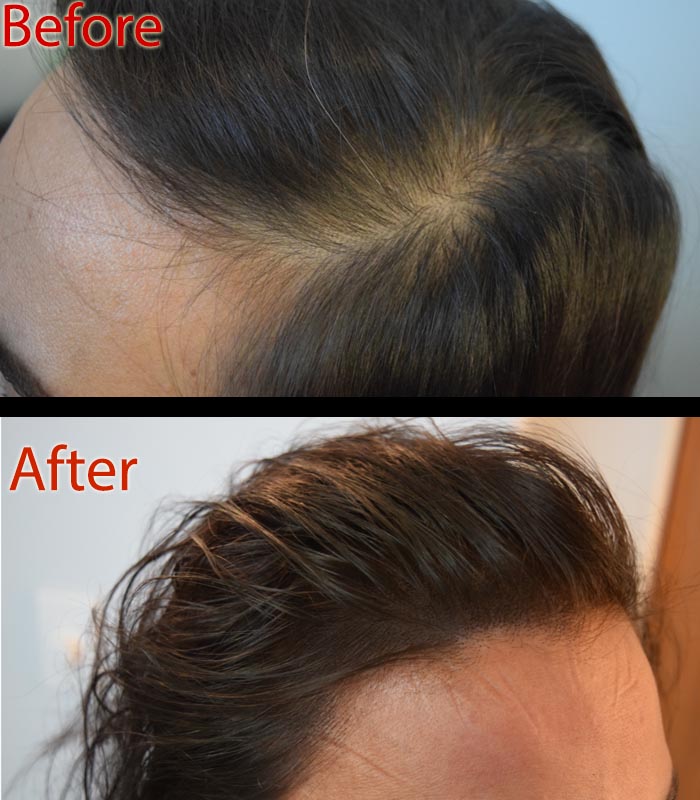
You part your hair the same way you always have, but lately the mirror tells a different story. The scalp shows through more than it used to. The line looks wider. If you are dealing with a widening hair part, you are far from alone. Over 30 million women in the United States experience this, and for most of them, it signals the early stages of female pattern hair loss.
Why Does Your Hair Part Keep Getting Wider?
Female pattern hair loss, also called androgenic alopecia, causes hair follicles to shrink gradually. Each hair that grows back comes in finer and shorter until some follicles stop producing hair entirely. The result appears first along the part line, often in what dermatologists call a Christmas tree pattern — wider at the front, narrowing toward the back.
Hormonal shifts, especially around menopause or postpartum recovery, speed this process up. Stress-related shedding, known as telogen effluvium, can also widen the part temporarily. Tight hairstyles, heat damage, and nutritional gaps in iron, protein, or zinc round out the most common triggers.
Can a Widening Hair Part Grow Back?
Many women ask this question, but the answer depends on how early you catch it and what is causing it.
If stress or nutritional deficiency drives hair thinning in women, addressing those root issues can restore density over time. Minoxidil, the only FDA-approved topical treatment for female hair loss, can slow the progression and stimulate some regrowth for many women.
Hormonal treatments work for women whose thinning is linked to androgen sensitivity. Supplements with biotin, iron, and omega fatty acids support scalp health but rarely rebuild visible density on their own. The key point: the earlier you act, the more options you have.
Do Hair Growth Serums Actually Fix a Widening Part?
Scalp serums containing peptides, caffeine, or niacinamide do support a healthier scalp environment and can reduce breakage. Pair them with a regular scalp massage to boost blood circulation, and they become a useful part of your routine.
But here is the truth — serums and even medical treatments take six to twelve months to show results, deliver inconsistent outcomes, and rarely restore the visible fullness that was lost along the part line. When the scalp clearly shows through, no serum closes that gap reliably.
How Scalp Micropigmentation Treats a Widening Hair Part in Women?
This is where scalp micropigmentation changes the conversation. SMP places ultra-fine pigment impressions directly into the scalp between existing hairs. These impressions reduce the contrast between your scalp and hair, making the part look denser immediately after the first session. Unlike regrowth treatments, SMP does not depend on the recovery of your follicles.
It works alongside whatever medical treatment you choose. It suits women with long hair because the pigment blends naturally beneath existing strands rather than creating any harsh or obvious appearance. Two to three sessions typically deliver a result that lasts for years with only minor maintenance needed.
How to Get Started?
SMP is highly effective, but its results depend entirely on the person performing it. This matters more because a growing number of tattoo artists have begun offering SMP as an add-on service without proper training. Traditional tattooing and scalp micropigmentation are completely different disciplines.
Tattoo needles penetrate deeper, tattoo inks migrate and blur over time, and the dot patterns differ entirely from what scalp work requires. A tattoo artist without dedicated SMP training cannot replicate natural follicle density for women with long hair — and the mistakes they leave behind are difficult and expensive to correct.
When you look for an SMP specialist, request a portfolio of real female clients with widening parts or thinning crowns. Look for natural-looking results, not heavy or patchy dots.
An Arizona SMP specialist understands how women lose hair differently from men and adjusts technique accordingly. Luckily, DermiMatch scalp artists in Arizona know that your scalp deserves that level of expertise — and with the right artist, a widening hair part does not have to define how you feel about yourself.